
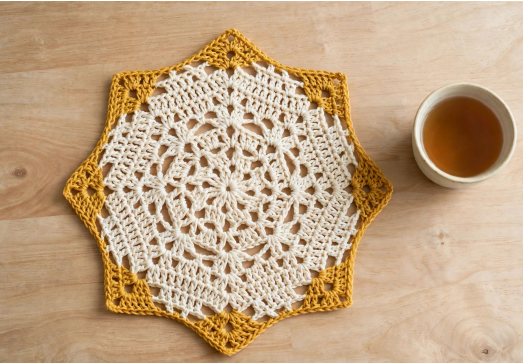
Mustard Yellow & Cream • Easy • About 6 inches across • About 1 hour
What you will make: a flat, sturdy hexagon coaster for a cup or a small plant pot. It is worked in rounds from the centre out, with 6 corners. Once you learn this hexagon, you can make it bigger for a placemat by adding more rounds in the same way.
Materials:
• DK / light worsted cotton yarn: Mustard Yellow approx. 30 g, Cream approx. 20 g (for one coaster).
• Crochet hook: 4.0 mm (US G-6).
• Scissors, tapestry needle, 1 stitch marker.
• Measuring tape (optional).
• Finished size: approx. 15 cm / 6 in from corner to corner. Size depends on your yarn, hook and tension.
Abbreviations — US terms :
ch = chain • sl st = slip stitch • sc = single crochet • dc = double crochet • st(s) = stitch(es) • sp = space • * * = repeat the instructions between the stars.
Note: The chain-3 at the start of a dc round counts as the first dc. Always join a round with a slip stitch into the top of the starting chain-3, unless the round says otherwise.
Before you start :
1. Keep your tension relaxed. If the hexagon curls up, go up to a 4.5 mm hook. If it ruffles and waves, go down to a 3.5 mm hook.
2. Mark the first corner space of each round if you lose count — there are always 6 corners.
3. Change colour neatly: finish the last stitch of the old colour up to the last yarn-over, then yarn over with the new colour and pull through.
Round 1 — Centre (Mustard Yellow) :
Make a magic ring. Ch 3 (counts as 1 dc), 1 dc in ring, ch 2, *2 dc in ring, ch 2* — repeat from * 5 more times. Join with sl st to top of ch 3. (12 dc, 6 ch-2 corner spaces)
Round 2 — Grow the hexagon (Mustard Yellow)
Sl st into the next ch-2 corner space. Ch 3 (counts as 1 dc), (1 dc, ch 2, 2 dc) in the same corner space — this is your first corner.
*Dc in the next 2 dc, (2 dc, ch 2, 2 dc) in the next ch-2 corner space* — repeat from * 5 more times. Join with sl st to top of ch 3. (36 dc, 6 ch-2 corner spaces) Fasten off mustard, or carry it if you prefer — cutting and rejoining gives a cleaner colour change.
Check: lay it flat. It should already look like a small hexagon, not a circle.
Round 3 — Cream round :
Join cream yarn in any ch-2 corner space. Ch 3 (counts as 1 dc), (1 dc, ch 2, 2 dc) in the same corner space.
*Dc in the next 6 dc, (2 dc, ch 2, 2 dc) in the next ch-2 corner space* — repeat from * 5 more times. Join with sl st to top of ch 3. (60 dc, 6 ch-2 corner spaces)
Tip: count one side before you finish the round — one side should be 4 corner dc + 6 middle dc = 10 dc, plus the corner chain. If a side is short, you have missed a stitch; if it is long, you have added one.
Round 4 — Border (Cream) :
Ch 1 (does not count as a stitch). Sc in each dc around, and work 3 sc in each ch-2 corner space. Join with sl st to the first sc. (78 sc) Fasten off and weave in all ends with the tapestry needle.
Finishing :
1. Weave in ends on the back, going through the stitches for at least 2 cm so they do not come out in washing.
2. Light blocking (optional but recommended): dampen the coaster lightly, lay it flat, shape the six corners with your fingers, and leave it to dry flat. Do not stretch it hard.
3. Make a set: repeat Rounds 1–4 three more times for a set of 4 coasters.
Make it bigger :
To make a placemat, keep repeating the Round 3 logic in your main colour: each new round adds 4 dc to the middle of every side. For example, the next round would be (2 dc, ch 2, 2 dc) in each corner, dc in the next 10 dc, repeat. Finish with one sc border round as in Round 4.
Care & troubleshooting :
• Wash: hand wash in cool water, dry flat. Cotton coasters can go in a gentle machine wash, but flat drying keeps the hexagon shape best.
• Curling up: your tension is tight — use a larger hook or work a little looser.
• Wavy / ruffled edge: your tension is loose or you added stitches — use a smaller hook and count one side.
• Uneven corners: check that every corner has (2 dc, ch 2, 2 dc) and that you did not skip the ch-2 space.
This pattern was written as a clear, original guide for this coaster. It is not copied from another designer’s pattern. Finished size depends on yarn, hook and tension.